
Creating inclusive multi-faith workplaces is a resource for DCA members to help workplaces move away from simply ‘accommodating’ the needs of their multi-faith employees, towards making workplaces inclusive for everyone in Australia’s increasingly religiously diverse workplaces.
The resource is designed to provide guidance to Australian workplaces about how to deal with a range of common faith-related queries, and also to provide workplaces with principles to help balance issues where conflicting rights might intersect.
From legal accommodation to inclusion
We want to elevate the conversations that we have each day so they respect and include all.
Inclusion is a higher aspiration than simply meeting the legal requirements to accommodate people of faith (or no faith) at work.
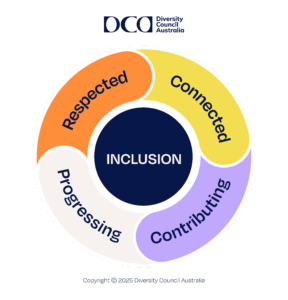
Inclusion in a workplace is achieved when a diversity of people (e.g. ages, cultural backgrounds, genders, perspectives) feel that they are:
- Respected for who they are and able to be themselves;
- Connected to their colleagues and feel they belong;
- Contributing their perspectives and talents to the workplace; and
- Progressing in their career at work (i.e. have equal access to opportunities and resources).
Balancing competing rights
A common question we receive at DCA is how to handle situations where someone’s religious beliefs, challenge another persons belief or identity, especially if this has an impact on the needs of the business.
There are no easy answers, but the principle of inclusion – ensuring that all employees are respected, connected, and able to contribute and progress – can help navigate some of these situations.
Want to use our research?
Materials contained in this document are © Copyright of DCA Ltd, 2019 and come under our Terms of Use and Privacy Statement. If you wish to use any content contained in this report, please contact DCA at research@dca.org.au, to seek consent.
Where you wish to refer to our research publicly, it must be correctly attributed to DCA.
- Formal attribution to DCA is required where references to DCA research material are in a written format.
- Citing DCA as a source will suffice where the reference is made in a verbal format.
The suggested citation for this report is:
Diversity Council Australia, Creating Inclusive Multi-Faith Workplaces, Sydney, Diversity Council Australia, 2019.
DCA members can also log in below to access the full guidelines.
To request an accessible alternative format of any document, please email admin@dca.org.au. Please let us know which format you need and for which document. While DCA will do its best to provide you with the alternative you need, please be aware that not all formats may be available.
Member-only content
Gain full access with DCA membership!
If your organisation has just signed up, your access will be activated as soon as payment is received.
Helpful resources
- See Tanenbaum’s Factsheets on some of the major religious festivals, events, and celebrations.
- Use the Australian Government’s Calendar of Cultural and Religious Dates to raise awareness of
key cultural and religious events, days and festivals. - See DCA’s Planning for Special D&I Days for a calendar of important diversity days and access
suggested workplace activities and information on specific religious days. - See the Fair Work Ombudsman’s information on Cultural & Religious Holidays and Compassionate
& Bereavement Leave. - See Loddon Mallee Regional Pallative Care Consortium’s An Outline of Different Cultural Beliefs at
the Time of Death. - See the Queensland Faith Communities Council (QFCC) Faith & Food: A Guide to Religious
Dietary Requirements. - See DCA, Inclusive Team Social Events.
- See Queerly Planning an Inclusive Event Reference Guide.
- See St. Ethelburga’s Centre for Reconciliation & Peace’s Recovering the Calm.
- See Tanenbaum’s Quiet Rooms: Getting Started.
- See European Network Against Racism’s Managing Religious Diversity in the Workplace:
A Good Practice Guide. - See DCA’s Words At Work: Building Inclusion Through The Power Of Language Guide.
- See Southern Poverty Law Center’s Responding to Everyday Bigotry.
- See VicHealth’s Bystander Action Toolkit Section 4.
Aboriginal and Torres Strait Islander Spirituality Resources
- Charles Sturt University’s Guide to Working with Indigenous Australian Staff.
- Common Ground’s articles on culture, history and reconciliation.
- Cooperative Research Centre for Aboriginal Health’s Spirituality and Aboriginal People’s Social
and Emotional Wellbeing: A Review and Aboriginal Spirituality: Aboriginal Philosophy the Basis of
Aboriginal Social and Emotional Wellbeing. - DCA’s Words At Work: Building Indigenous Cultural Inclusion through the Power of Language
Guide. - Dreamtime’s Spirituality and Aboriginal Dreamtime Stories.
- Fair Work Ombudsman’s Supporting Workers During Sorry Business.
- Generation One and Reconciliation Australia’s Everybody’s Business: A Handbook for Indigenous
Employment.