
Longer-term actions for supporting inclusion in difficult times

DCA’s research on organisational change outlines a concrete process to follow. Read Change at Work: Designing Diversity and Inclusion differently to achieve organisational change.

Table of Contents

Cultivate a culture of diversity-related psychological safety

Diversity-related psychological safety is an environment where employees feel safe discussing events and/or experiences that are associated with their identities. 1

Psychological safety refers to the degree an individual can take interpersonal risks such as expressing their identity or admitting a mistake, without the fear of backlash. 2 When employees have diversity-related psychological safety they feel safe to express their experiences and feelings relating to their identity.

Research has found that when employees felt comfortable discussing difficult times events at work, it largely prevented those events from negatively affecting their work behaviour. 3

Steps to creating diversity-related psychological safety in the workplace

  • Reflect and understand your team’s culture. Both as a leader and as a team, reflect on your workplace culture and examine whether the team feels the need to cover up or hide identity expression in the workplace. Try using Deloitte and Meltzer Centre for Diversity, Inclusion and Belonging’s “Uncovering culture worksheet: Examine covering with your team” template to better understand your team culture (page 20 in the report). When doing this make sure you have created safe spaces for team reflection and for centring marginalised voices (see DCA’s Centring Marginalised Voices at Work guide).
  • Focus on learning and growing. Rather than focusing on being right, focus on learning and growing together as a team, where conversations around diversity and inclusion are seen as a learning opportunity for the team. This ensures that there is a culture of ongoing conversations and learning – where the team can bring up issues, thoughts and experiences knowing that their voices are respected and valued.
  • Create safe space. Create psychologically safe space for employees from marginalised backgrounds to speak up, share their lived experiences, ideas and concerns without backlash (DCA’s Centring Marginalised Voices at Work guide outlines how to create safe space).
  • Listen deeply. Listen carefully, and genuinely try to understand the experiences of employees who are marginalised. Do not downplay, challenge or ignore what people from marginalised backgrounds are telling you about their lives and experiences (DCA’s Centring Marginalised Voices at Work guide outlines how to listen deeply).
  • Foster relationships of respect, trust and value with everyone in the team through communication and consultations. 4 Seek advice from multiple perspectives and be transparent 5  about how employees from marginalised backgrounds’ expertise and lived experience will influence the work towards addressing difficult times. Ensure that these consultations or conversations are genuine and in collaboration with the team. 6

Understand and enable effective allyship

Educate about effective allyship to create a culture where team inclusion is everyone’s responsibility. This ensures that during difficult times, it is not only the employees from marginalised backgrounds who address the effect of events in their workplace, but everyone in the team proactively supports each other.

What is an ally? An ally is someone in a position of relative privilege (e.g. a white team member might be an anti-racism ally) who:

  • supports marginalised communities through ongoing, intentional actions, in the way the communities prefer, and
  • takes action to address inequity, even if it’s uncomfortable, unrecognised, and comes at a personal cost. 7

Have the team watch and read the following DCA webinars and resources together, discussing and co-designing 8 a plan of action on creating an allyship culture:

Create a person-centric and trauma-informed workplace

Difficult times can create or increase trauma for employees affected by the events. Trauma can affect how employees function, work and feel connected in the workplace. Trauma is described as “witnessing or experiencing an extreme stress that overwhelms a person’s ability to cope or contradict one’s worldview.” 9 It includes secondary traumatic responses (vicarious trauma) where the employee hasn’t necessarily experienced the event firsthand but is still affected by it through witnessing or hearing about it.

Creating a person-centric and trauma-informed workplace can support employees who are experiencing trauma or increased trauma during difficult times. The Australian Human Rights Commission defines person-centric approaches as keeping the person at the centre of decision-making, planning and choices about how the organisation or business will respond with transparency and accountability. It ensures that we centre marginalised voices and lived experience in the approach. In the table below, the AHRC explains the differences between person-centred and system-centred approaches.
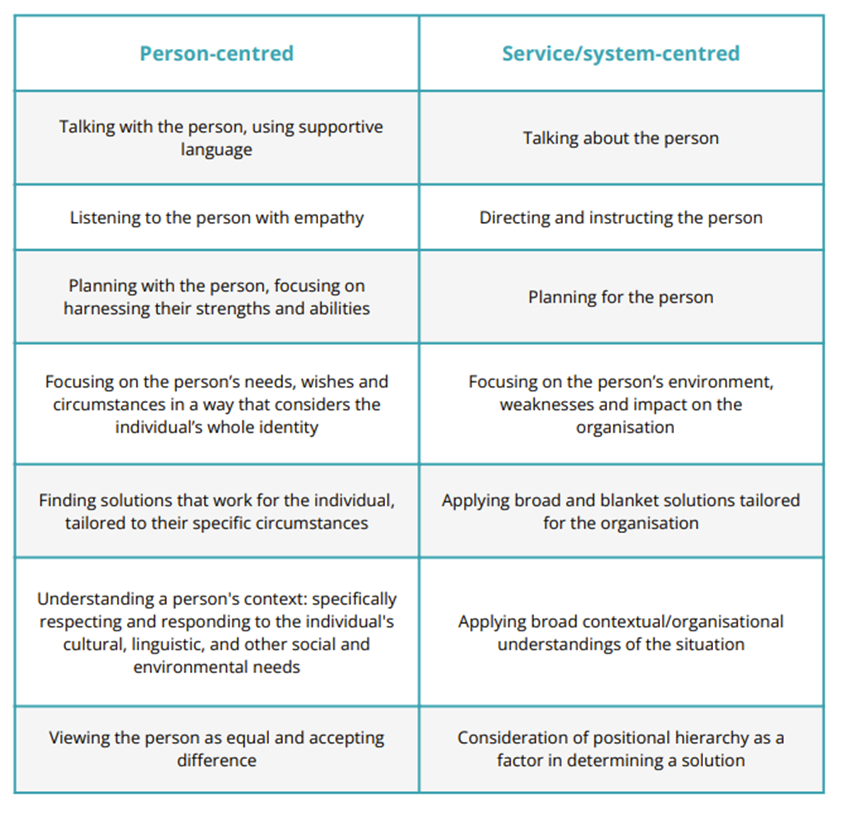
Table comparing person-centred approaches to systems-centred approaches

The following are practical resources on creating a trauma-informed approach in the workplace:

Support services

This webpage discusses events and systemic discrimination which have harmed or continue to harm communities.

If you or someone close to you is in distress or immediate danger, call 000 as soon as possible.

Should you need support, please contact mental health support agencies, such as:  

 
  1. Leigh, A. & Melwani, S., "Supporting employees after violence against their communities," Harvard Business Review, 5 October 2022
  2. Amy Edmondson, ‘Psychological Safety and Learning Behavior in Work Teams’, Administrative Science Quarterly 44, no. 2 (1 June 1999), p. 350–83,;

    Gardner, D.M. “The consequences of being myself: Understanding authenticity and psychological safety for LGB employees,” The British Psychological Society, 2022, p. 1-10

  3. Leigh, A. & Melwani, S., "Supporting employees after violence against their communities"  
  4. B. Bhattacharyya, S. Erskine, C. McCluney, “Not all allies are created equal: An intersectional examination of relational allyship for women of color at work,” Organizational behavior and human decision processes, Vol. 182, May 2024, p. 18
  5. Diversity Council Australia (V. Mapedzahama, F. Laffernis, A. Barhoum, and J. O’Leary). Culturally and Racially Marginalised Women in Leadership: A framework for (intersectional) organisational action, Diversity Council Australia, 2023
  6. Ibid.
  7. Diversity Council Australia, Allyship: Inclusive Teams at Work, Sydney, Diversity Council Australia,
    2024
  8. See DCA’s Centring Marginalised Voices at Work: Lessons from DCA’s Culturally and Racially Marginalised (CARM) Women in Leadership Research, which outlines the steps of co-diagnose, co-design, co-deliver, and co-evaluate
  9. Rees, S and Moussa, B. "Invisible wounds of the Israel Gaza War in Australia" Medical Journal Australia, 2024, Vol. 220, no. 1 p, 4- 6